Even for expert gardeners, choosing your next plant at the garden center can be a puzzling experience. With so many choices, it’s easy to feel at a loss of where to even begin. Besides asking for help, the key to success is to know how to understand plant tags. These simple but essential little cards provide a wealth of information to help you choose and grow your plants. This guide helps you understand these tags, with an additional guide on gardening zones!
What Do the Symbols on a Plant Tag Mean?
On any plant tag, you’ll find symbols of suns, rain drops, zone numbers, measurements, and sometimes other pictures. This is not just artwork to beautify the tag. These symbols are space-efficient ways of telling you the light, water, spacing, and other needs of each plant. Below you’ll find a guide for each symbol:
Let’s Start with the Front of the Plant Tag
Whenever you’re looking for a new plant, the front of the tag tells you the common name in standard font, and the latin, scientific name in italics. If applicable, it will also have the name of the cultivar in quotation marks after the common name. In addition, it features a handy picture of the plant, usually in full bloom. All of this helps you know what plant species and variety you’re looking at.
How to Look for Plant Dimensions
On the backside of the tag, you’ll find more information about the plant’s dimensions. A simple depiction tells you how tall and wide it will grow at a mature size, and how much space it needs between other plants.
Whether you’re choosing your next tree or perennial, you need to know the mature size beforehand to ensure you have enough room in your garden.
How to Decipher Light Requirements
To understand the plant you’re about to buy, you need to know how much light it needs. Instead of writing an essay on the topic, plant tags tell you with a small symbol. You’ll see a full sun, half-sun, or full shaded sun. As you can guess, each has a specific meaning:
How to Read Water Requirements
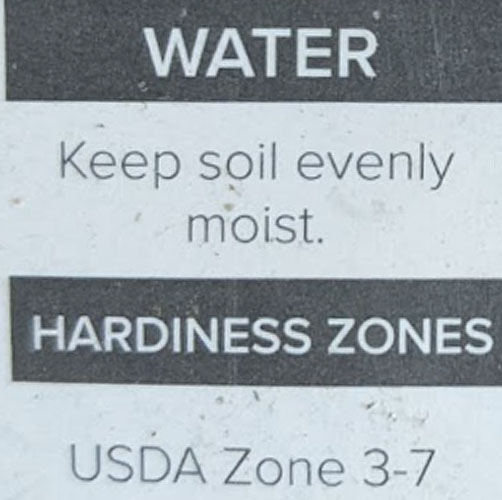
Again, knowing how much water your plant needs is important to understand before you buy it. Together with its dimension and light preferences, water needs tell you where that plant will thrive on your property. On a plant tag, you’ll find drops of water, which tell you the following:
💧One Raindrop: means that this plant prefers dry conditions, and likes to dry out in between waterings.
💧💧 Two Raindrops: means this plant has “normal” water needs; in other words, that the top inch of soil can dry out, but should remain moist beneath that.
💧💧💧 Three Raindrops: indicates a water-loving plant, which likes to have moist but not waterlogged soil.
How to Understand Hardiness
On any plant tag, you’ll also find the hardiness zones where the plant can survive. In general, hardiness regions are climatic zones that indicate where plants can grow. They’re determined by the average annual minimum temperature in that region. There are 13 different zones in North America. A plant tag may say, “Zones 3-7,” which means the plant can grow anywhere in those zones.
Growing zones are also divided into “a” and “b,” for example, growing zone 4b. This is just a way to further classify growing opportunities in each region. The “b” indicates a warmer part of that zone.
Hardiness Zones in North Dakota
The lower numbers of hardiness zones indicate colder winters. It should be no surprise, then, that North Dakota is situated in zones 3 to 4. The upper third of the state is in zone 3b with some pockets of 3a. The lower two thirds of North Dakota is mostly in 4a with a few small regions of 4b. Here in Bismarck, we’re right in the middle of 4a, where temperatures go down to -25 to -30 F in winter.
How to Choose Plants According to Zone in Bismarck
When choosing a plant for your garden, make sure it can grow in zone 4. Any plant that is not hardy to zone 4 likely won’t survive the winter here. With that said, you can still grow them outside during the growing season. You just have to overwinter them indoors or treat them as an annual. Many annuals in our region are actually perennials in warmer climates.
Additional Care Features on a Plant Tag
Besides the above information, you’ll also find additional care tips on each plant tag. For example, you may find notes about fertilizer requirements, drought tolerance, deer hardiness, pruning needs, or whether you can step on it or not. If there’s anything you need to know that’s not on the label, just ask a staff member and we’d be happy to find the information!
Pro Tip:when you take your plant home, it’s helpful to hold onto your plant tag, or record the information in your gardening journal. This serves as a reminder for proper care, and to remember the specific variety for future reference.
Going to a garden center doesn’t have to be a dizzying wander through a maze of plants. Once you know how to read plant tags, you can easily navigate your way to your next plant selection. For any other questions on plant tags or care, a member of our garden center would be happy to assist you!